Dr. Brooks’ Apothecary
The back office of the druggist who built the Manor. Mind the acid.
Prescriptions carefully compounded · Est. 1878The Manor was built around 1889 for druggist William T. Brooks, according to a 1988 National Register survey. That survey says he ran a drugstore in downtown Paris “for several decades.” The old Bourbon County newspapers fill in the rest: several store names, a phonograph department, a fight with City Council, and one very bad day with a bottle of acid. Everything here comes from those papers unless it’s marked Manor lore · unverified.
- Timelinethe ledger
- The Storeon Main
- Clippingsthe corkboard
- Privy Findsthe glass
- Sourcesthe fine print
DRAWER IThe Prescription Ledger
The store’s names over the years. One druggist and five signboards.
- 1878
“Established 1878”
That’s what the firm’s own ads said in 1918. They don’t say what began that year.
Brooks & Snapp ad, The Bourbon News, Feb. 15, 1918 - 1881–82
Downey & Brooks
Druggists W. H. Downey and W. T. Brooks were partners in Paris. A later county note says Downey “sold out on account of failing health to his partner, W. T. Brooks.”
Kentucky State Gazetteer, 1881–82 · undated Bracken Co. note - 1882
W. T. Brooks’ Drug Store
It sold more than medicine. Reserved seats for Blind Tom’s concert were sold there, and so were 50-cent cabinet photos of the evangelist Rev. Geo. O. Barnes and a glove cleaner. The clerk was “the very agreeable young” D. C. Lyman.
The Bourbon News, Apr. 25, May 9 & Sept. 26, 1882 - 1883
Brooks & Lyman
The firm became Brooks & Lyman, with Dr. David Lyman as partner. They held an “opening” with speeches in June, and that Christmas they stocked “a thousand articles—just as handsome as handsome can be.”
The Bourbon News, June 5, 1883 · Semi-Weekly Bourbon News, Aug. 31 & Dec. 11, 1883 - 1884–94
The missing pages
No Paris papers from these years have been digitized, so the store goes quiet here. This is the decade the Manor went up.
- c. 1889
The Manor is built
“Built c. 1889 for William T. Brooks, proprietor of a drugstore in downtown Paris for several decades.” His mother, Elizabeth, came to live with him in Paris around 1891.
1988 National Register survey · her obituary, The Bourbon News, Mar. 14, 1913 - 1897–1914
W. T. Brooks Drug Store
Dozens of patent-medicine ads in these years end with the same line: “W. T. BROOKS, Druggist.” By 1912 the paper called him “the Main street druggist.”
The Bourbon News, 1897–1914, e.g. Sept. 16, 1910 & Nov. 15, 1912 - 1917
Brooks & Snapp Drug Co.
Dr. Elbridge Snapp “has recently become associated in the drug business in this city with Dr. W. T. Brooks,” the paper reported. The firm called itself The Penslar Store, at 415 Main Street.
The Bourbon News, June 19 & Aug. 28, 1917; Feb. 15, 1918 - 1921
The Phonograph Department
E. L. Snapp ran a phonograph counter inside the drug store and sold Pathé machines and records.
The Bourbon News, Oct.–Dec. 1921 - 1922
The paint fight
Dr. Brooks went before City Council to object to paying an extra license for selling paint. The Council made him pay.
The Bourbon News, Feb. 14, 1922
DRAWER IIThe Store on Main
What the druggist sold, said and suffered, labeled like the bottles on his shelves.
Brooks’ Cold Tablets
25¢ a box. Contains no harmful drugs. A simple but effective remedy.
In the same 1918 ad: Penslar White Pine and Spruce Balsam, Hazola Toilet Cream, and hot water bottles at $1.25 to $1.50, “in this cold weather.”
415 Main Street
“Brooks & Snapp Drug Co. · Established 1878 · 415 Main Str.” is the Main Street drug store in downtown Paris. It was “The Penslar Store,” and it promised “the best prescription service in town.”
The Bourbon News, Aug. 28, 1917 & Feb. 15, 1918Phonographs & Records
For Christmas 1921 the drug store had a Phonograph Department, run by E. L. Snapp. Buy a Pathé and get $25.00 worth of records free.
Fountain pens, pipes, cigars and Block’s Fine Candies were on the counter too.
The Paint License
In February 1922, Dr. Brooks appeared before the Council and objected to “paying an additional license for selling paints.” He declared that sale of paints had always been recognized as part of the drug business.
The Council disagreed, and the City Attorney was told to collect.
Tickets at the Drug Store
In 1882 you bought your theater seats from the druggist. Reserved seats for Blind Tom at Odd Fellows Hall cost 50 and 75 cents “at W. T. Brooks’ drug store.” Seats for later shows were sold at “Brooks & Lyman’s.”
The Bourbon News, May 9 & Nov. 1882The Fresco
The whole report, from May 1882: Brooks, the druggist, beautifully frescoed his face with hide-scalding acid the other day.
The paper never followed up. We hope it healed.
A Family of Druggists
Brooks wasn’t the only druggist in the family. His brother, Dr. Joseph J. Brooks, was “a prominent druggist of Richmond” for twenty years and spent his last years living with W. T. in Paris. He died there in 1910. Their mother, Elizabeth Brooks, was born in 1829 in Rockcastle County and was the widow of Richard A. Brooks, “a Virginian.” She lived with her son in Paris for about 22 years and died in 1913. Brooks married into the Joplin family of Mt. Vernon. In 1918, as a widower, he married Miss Ella Joplin, his late wife’s sister, who had taught on the Paris High School faculty.
The Bourbon News: June 10, 1910; Nov. 15, 1912; Mar. 14, 1913; Feb. 15, 1918
DRAWER IIIThe Corkboard
Clippings tacked up over the back-office desk. Tap one to read it up close. All come from Chronicling America at the Library of Congress.
DRAWER IVPrivy Finds
His own bottles came home. The curator dug these from two privies in the Manor’s back yard.
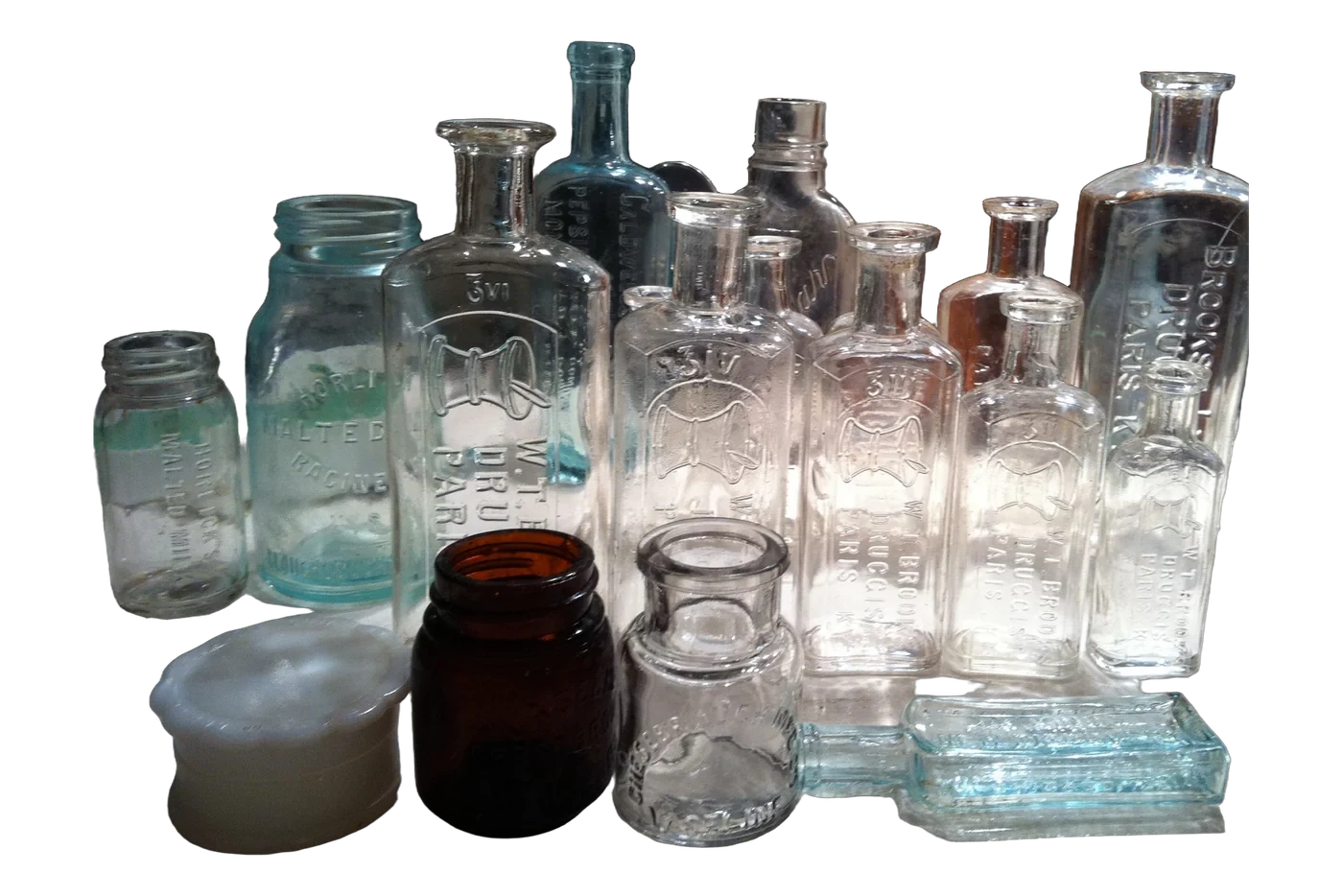


Prescription bottles like these went home with customers, and many ended up thrown away in back-yard privies. These ones went into the privies behind the house their druggist built. The 1918 papers also mention a house brand, Brooks’ Cold Tablets, sold by the box.
see also the Builder’s Bottles in the Bottle Cellar →From the Curator’s Shelf
More of his glass, photographed fresh on the Manor’s shelves. The photos are toned so the lettering in the glass shows up. Tap a bottle for the full-size photo.


Other Paris Druggists
Mr. Brooks had competition. These are from the same shelf, made for other Paris drug stores.


The rest of that shelf, including Barnes & Hall of Lexington, a cobalt blue bottle and a Dr. Wood’s Sarsaparilla, is down in the Bottle Cellar.
see also the Druggist’s Shelf in the Bottle Cellar →DRAWER VThe Fine Print
Back-Room Whispers
- A secondary death index lists a William T. Brooks who died January 1, 1935, aged 83, in Bourbon County. No obituary has turned up to confirm it.
- A Mt. Vernon paper once said the oldest drug house in that town was “established by W. T. Brooks, sometime in the sixties.” That could be him as a very young man, or a relative.
- The papers call him “Dr.” Brooks. It was probably the courtesy title that druggists of the time often got.
- The bottles that read just “W.T. BROOKS” may date from the years he ran the store alone, before Brooks & Snapp. That’s a guess, not a fact.
- The papers never mention this, but some say the back office still smells faintly of hide-scalding acid.
SOURCES
- Newspapers: Chronicling America: Historic American Newspapers, Library of Congress. The Bourbon News (Millersburg, 1881–83, and Paris, 1895–1922) and Semi-Weekly Bourbon News (Paris, 1883). Each clipping links to its full page. loc.gov/chronicling-america
- Kentucky State Gazetteer and Business Directory, 1881–82, Paris listings: “Downey & Brook (W H Downey, W T Brooks), druggists.” transcription
- The note on Wm. H. Downey selling out to W. T. Brooks (undated): KYGenWeb, Bracken County
- The Manor’s construction date and its builder: a 1988 National Register of Historic Places survey.
- Mt. Vernon Signal items (transcribed): USGenWeb Archives
The clippings are cropped from public-domain page scans, and the text was checked against the page images. The Library of Congress’s digitized Paris papers have a gap from 1884 to 1894.